
Sense–Forecast–Adapt Challenge: a modular, adaptive building prototype in three weeks
This year’s Laboratory Student Competition is a build-driven challenge where teams will design, fabricate, assemble, instrument, and test a modular three-storey (or four-level) building prototype that embodies the programme theme: Sense–Forecast–Adapt for Adaptive and Proactive Resilience. The competition is intentionally multidisciplinary: it combines structural design, topology optimization, digital fabrication, assembly/disassembly, sensing and embedded systems, active elements/actuation, computer vision (optional), and forecasting-informed decision logic. The final objective is to deliver a working physical prototype—not a concept—verified through a set of standardized performance tests.
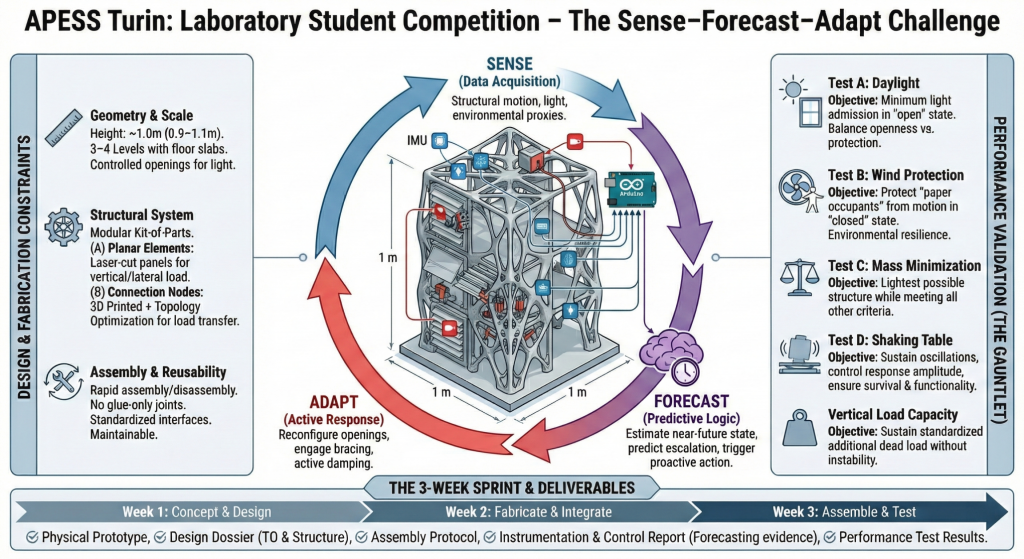
1. Core prototype requirements (mandatory)
1.1 Overall geometry and scale
Each team must realize a scaled building with the following target characteristics:
- Height: approximately 1.0 m (target range: 0.9–1.1 m).
- Number of storeys / levels: 3 storeys minimum, 4 levels maximum (e.g., ground + 3 floors).
- Floor system: each storey must include a slab (floor plate). The slabs define the usable “interior volume” and will host sensors and hardware.
- Openings: the building must include openings (e.g., façade perforations, windows, voids, or adjustable apertures) to enable a controlled amount of light to enter.
The prototype should be visually and structurally recognizable as a “building,” with clear floors, vertical load paths, and façade/opening logic.
1.2 Structural system and fabrication concept
The building must be designed as a modular kit-of-parts, with a clear separation between:
(A) Supporting planar elements (primary vertical/lateral system)
- The main vertical and lateral load-bearing elements will be planar components (e.g., shear-wall panels, frames, or folded plates).
- These planar components are intended to be produced via laser cutting of panels (materials will be defined by the organizers depending on lab availability—e.g., plywood, acrylic, composite board).
- The planar elements must be arranged to provide global stability and to create interior volume and openings.
(B) Connection nodes (high-value innovation zone)
- Connections between planar elements and slabs must be realized using topology optimization + 3D printing.
- The connection design should be treated as a structural “product” that:
- transfers vertical loads (gravity + imposed vertical weight),
- transfers lateral loads (wind + shaking-table action),
- enables rapid assembly and disassembly, and
- supports reconfiguration where relevant (e.g., alternate bracing/locking states, façade panel states, adjustable apertures).
Key principle: the printed nodes should not be decorative; they must be the engineered mechanism that makes the building feasible, modular, and robust.
1.3 Assembly/disassembly and reusability
The building must be assembled and disassembled within a reasonable time by the team, using a repeatable method. The prototype should:
- allow disassembly without destroying key elements;
- use standardized interfaces where possible;
- be designed for maintainability (e.g., sensors replaceable, wiring accessible);
- avoid glue-only solutions as the primary structural mechanism (fasteners, interlocks, pins, clamps, or printed locking systems are encouraged).
This criterion is essential: resilience is not only “strength,” but also repairability, replaceability, and adaptation.
2. Sensing, embedded monitoring, and active elements (mandatory)
2.1 Arduino-based system architecture
Each team must install a system based on Arduino (or Arduino-compatible) hardware that provides:
- Sensing: at least one structural response modality (e.g., acceleration/IMU) and ideally additional sensors (e.g., displacement proxy, light sensor, wind proxy, temperature).
- Data acquisition and logging: minimum capability to stream or store measurements during tests.
- Real-time decision/control capability: the system must be able to trigger actions based on sensor inputs and/or forecasted conditions (see forecasting section).
2.2 Active element / actuator integration
The building must include at least one active element (actuator) that can be coordinated by Arduino. Examples include (non-exhaustive):
- servo-controlled shutters or adjustable openings (façade apertures),
- a small active mass element (roof-level mover, if feasible),
- a locking/unlocking mechanism for a brace, panel, or joint,
- an adaptive damping element (simple controlled friction clamp),
- a reconfiguration actuator that changes the structural state (e.g., engages a stiffening panel).
The “active” component must be meaningful in relation to the performance tests (light/wind/shaking), not just a motor moving without impact.
2.3 Computer vision (optional but encouraged)
Teams may optionally integrate computer vision as a second sensing modality, for example:
- displacement tracking of floor corners via markers,
- drift estimation from video,
- detection of oscillation amplitude or mode shape,
- confirmation of “paper occupant” movement during wind tests.
Computer vision is aligned with modern SHM practice and can be used to strengthen the senseable narrative and the validation of forecasting and control logic.
3. Performance tests and scoring (mandatory)
The competition will be judged through a set of standardized tests, designed to evaluate comfort/performance, resilience, adaptability, and efficiency. The tests are deliberately multi-objective: you must balance light admission, wind protection, mass minimization, and dynamic performance.
3.1 Test A — Daylight / light-admission performance
Objective: ensure that the building allows a prescribed amount of light into the interior through openings.
Test concept:
- A standardized light source will be placed at a fixed distance and orientation.
- Light will be measured inside the building using a standardized sensor position (or multiple positions).
- The building must achieve a minimum light level (threshold) under an “open configuration.”
Interpretation:
- Larger openings increase light but may compromise wind protection and stiffness.
- Adaptive façade/openings (controlled by Arduino) give you a strategic advantage: open when required, close when threatened.
3.2 Test B — Wind protection with “paper occupants”
Objective: protect the interior volume from wind-driven disturbance.
Test concept:
- A standardized fan will generate wind directed toward the building.
- A set of small paper figures (“paper occupants”) will be placed inside at defined locations.
- In a “closed configuration,” the goal is to prevent motion of the paper occupants.
Winning criterion (as defined):
If the paper figure is not moving under the wind test when the building is in the closed configuration, your design performs strongly in this category.
Engineering message:
This is a controlled demonstration of environmental resilience: an adaptive envelope must protect interior conditions while still enabling openness and livability.
3.3 Test C — Mass minimization (lightweight resilience)
Objective: make the building as light as possible while still satisfying the other criteria (light admission, wind protection, vertical load capacity, dynamic performance).
- Total mass will be measured.
- A lighter structure is beneficial but will generally be harder to stabilize under shaking and vertical loads—this is a real design trade-off.
3.4 Test D — Shaking table dynamic performance
Objective: ensure the building sustains oscillations under base excitation and controls the maximum response.
Test concept:
- The building will be placed on a shaking table (or standardized motion platform).
- The building will be excited by a prescribed input (or series of inputs).
- The key performance metric will be the maximum oscillation (e.g., roof displacement proxy, acceleration RMS/peak, or drift proxy), plus qualitative survival (no collapse, no loss of function).
Requirement:
The building must remain stable and retain its functional configurations (open/closed, sensing, actuation) after the shaking test.
4. Vertical load capacity (mandatory)
In addition to wind and shaking, the building must demonstrate vertical load capacity, consistent with real structural demands.
4.1 Vertical weight test
- A standardized additional vertical weight will be applied (method to be defined by the organizers: e.g., discrete masses placed on slabs or roof).
- The building must sustain this weight without loss of stability or catastrophic damage, and without permanent deformations that prevent disassembly.
Design implication:
Your topology-optimized nodes and panel system must create a clear vertical load path—“pretty geometry” is insufficient without load transfer.
5. Forecasting activities (mandatory component)
To reflect the programme theme Sense–Forecast–Adapt, each team must implement a basic forecasting workflow that informs the building’s adaptive actions.
5.1 What forecasting means in this competition
Forecasting does not mean “predict everything.” It means:
- use current sensor data to estimate the near-future state (e.g., next 2–10 seconds),
- predict an escalation (wind increase, shaking intensity, resonance risk),
- and trigger proactive actions (close openings, engage stiffening, change controller gains).
5.2 Minimal forecasting deliverable
Each team must deliver at least one of the following:
- Wind escalation forecast: predict increased disturbance (e.g., from fan state or measured vibration) and close façade prior to peak.
- Dynamic response forecast: predict that oscillation will exceed a threshold and activate an actuator (e.g., engage a brace lock or change damping state).
- Light/wind scheduling forecast: switch between “open” and “closed” states based on forecasted environmental conditions.
Evidence required:
Teams must present a short “forecast vs measured” comparison plot and describe the intervention logic.
6. Optional extension — Drone-carried components for rapid adaptation
Teams may optionally propose and/or demonstrate a “rapid intervention” concept consistent with real resilience workflows:
- In case an event is forecasted (wind escalation, predicted high drift, predicted shaking), a drone-delivery scenariocan be used to represent rapid deployment of:
- a clip-on monitoring pod (extra sensor module), or
- a lightweight retrofit component (additional brace, damper module, façade panel).
This is not meant as a robotics show. It is framed as a resilience logistics workflow: forecasting triggers action, and the system’s capacity to accept and integrate modular components is part of the design.
A full drone demonstration is not required; a well-designed interface and “delivery plan” with a convincing physical mock-up will be evaluated positively.
7. Expected outputs and deliverables (what each team must submit)
Each team will provide:
- Physical prototype (1 m building, 3–4 levels, slabs, panels + 3D printed TO nodes)
- Assembly/disassembly protocol (step-by-step, with photos/diagrams)
- Design dossier including:
- structural concept and load paths
- topology optimization assumptions (objective, constraints)
- bill of materials
- Instrumentation and control dossier:
- sensor list and placement
- Arduino wiring/logic
- actuator description and control strategy
- optional computer vision method
- Performance report:
- light test results
- wind test results (paper occupant criterion)
- total mass
- vertical load test results
- shaking table response metrics
- Forecasting demonstration:
- forecast method
- intervention logic
- plot(s) comparing forecast and measured response
- Optional: drone intervention concept (module design + interface + scenario)
8. Summary: what this competition rewards
This competition rewards teams that can deliver a structure that is:
- buildable and modular (designed for assembly/disassembly),
- lightweight yet robust (mass minimization with stability),
- adaptive (open when light is required, closed under wind),
- smart and proactive (Arduino sensing + actuators + forecasting-driven decisions),
- validated experimentally (clear metrics and repeatable tests),
- and optionally deployable at speed (drone-enabled modular intervention concept).