APESS activities in detail
Lectures
The APESS 2026 academic program is designed as an Excellence Doctoral Course, featuring a faculty of world-renowned international professors. Moving beyond traditional classroom boundaries, these lectures are specifically tailored to be functional to the experimental laboratory goals, providing the theoretical backbone for the hands-on challenges at Fablab Torino.
Our curriculum bridges the gap between structural engineering, digital fabrication, and data science through a multi-disciplinary approach:
Core Academic Pillars
- Computational Design & Topology Optimization: Learning the mathematical foundations to minimize weight while maximizing structural performance—essential for the 3D-printed nodes students will produce.
- Advanced 3D Printing for Engineering: Exploring the materials science and additive manufacturing techniques required for modular, large-scale structural components.
- Structural Health Monitoring (SHM): Mastering the principles of sensing and vibration analysis to turn a static frame into a “living,” data-producing organism.
- Data Processing & Signal Analysis: Leveraging advanced algorithms to interpret the raw data stream coming from the Arduino-based sensor networks.
- Forecast Modeling & Predictive Control: Studying short-horizon response forecasting to enable structures that don’t just react to loads, but anticipate them.
Every teaching session is strategically placed to feed directly into the experimental sessions. This ensures that PhD candidates and researchers can immediately apply complex concepts, such as active damping or computer vision, to their physical prototypes.
The program culminates in the ANCRiSST Workshop where the participating doctoral students will attend distinguished keynote plenary lectures and share their research activities with the community in the parallel sessions of this conference edition.
The lectures and the laboratory activities lead the students to the Final Group Presentations, where the synthesis of these theoretical lectures and the laboratory results will be evaluated by our international panel of experts.
Hands-on Laboratory Sessions
From Design to Adaptive Reality
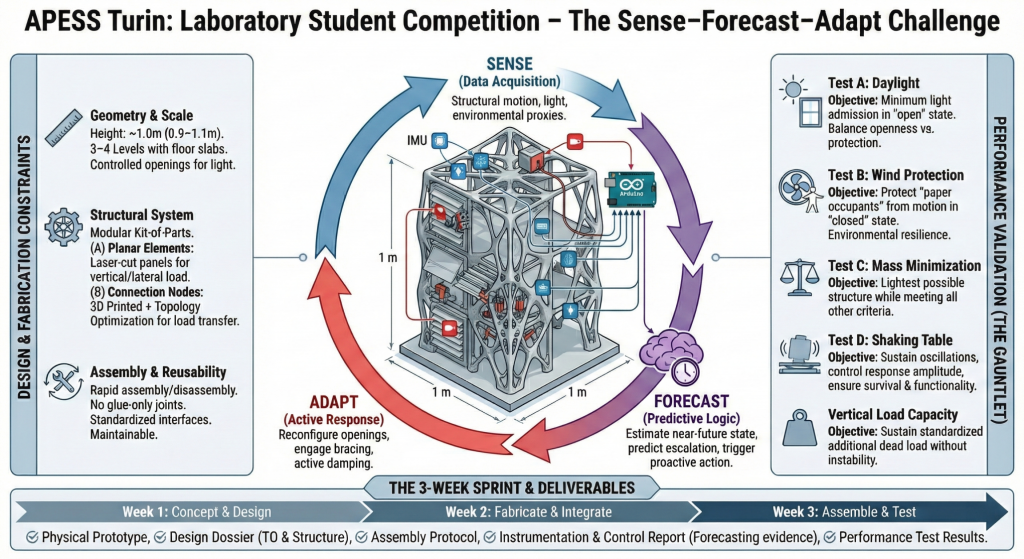
This year’s edition of APESS introduces a unique, build-driven experience centered on a complete integrated pipeline: Design → Print → Instrument → Forecast → Control.

The core of the practical experience will take place at Fablab Torino, the first Italian fabrication laboratory and a hub for digital innovation. In this creative environment, student teams will tackle the challenge of creating an adaptive 3-to-5 storey frame using topology-optimized numeric control laser-cut-shaped and 3D-printed components.
Key Laboratory Features:
- Building the Future: Students will assemble modular structures using advanced mechanical components and 3D-printed nodes designed during the first week.
- Smart Instrumentation with ARDUINO: Thanks to our partnership with Arduino, each team will have access to professional-grade boards and sensors. Participants will learn to instrument their structures for real-time monitoring, embedded sensing, and active vibration control.
- Intelligence & Control: Beyond simple sensing, the labs focus on “Sense & Act” and “Forecast & Adapt” workflows. Teams will implement computer vision and short-horizon forecasting to enable structures that proactively reconfigure themselves to mitigate dynamic loads.
- The Final Showcase: The program culminates in a live technical competition where each prototype’s ability to sense, forecast, and adapt to environmental demands will be put to the ultimate test.
By combining the academic excellence of APESS with the versatile ecosystem of Arduino and the cutting-edge facilities of Fablab Torino, we provide students with the tools to transform theoretical structural dynamics into smart, responsive prototypes.

Technical Visits: From Theory to Industry
To complement the academic lectures and the intensive laboratory experiences, the APESS 2026 program includes a series of curated Technical Visits (scheduled for July 18, 19, and 26).
These visits are specifically designed to be functional to the school’s objectives, offering students a first-hand look at large-scale applications of:
- Advanced Additive Manufacturing in industrial environments.
- Real-world Structural Monitoring of complex infrastructures.
- Smart Cities & Adaptive Building implementations.
Stay Tuned! We are currently finalizing partnerships with leading engineering firms and research centers to provide an exclusive behind-the-scenes experience. The official list of host sites will be announced soon.
APESS 2026 Summer School Main Activities Summary

Lectures
3D Printing
Topology Optimization
Structural Health Monitoring
Data processing
Forecast modeling

Lab Sessions
Hands-on with Arduino Microcontrollers, IoT Sensors, Actuators, and more
Create a Scaled Building Prototype
Sensing and Active Systems